Thursday, 29 March 2012

Poster research - V&A

Whilst at the museum wondering around I discovered a new section, the 'Theater and Performance' gallery. They had a variety of things there- from costumes, tickets, posters, videos, and small scale set designs. I took some pictures of the walls of posters to add to inspiration for designing the advertisement of our collection of clothing.
The plan for this campaign (of sorts) is to get the university involved with our project and ultimately make them aware of stresses the fashion industry puts on the environment. Were all going to design posters and put them around the different buildings, classrooms and our halls/houses.
Cimg0474
Cimg0475

Saturday, 24 March 2012

Swoon

Found this piece of art by Swoon, which I think really fits in with the idea of a communities merging together to create one. Swoon created the structure using NY garbage and has since created a gathering of people that join and float along with her...

http://nymag.com/arts/art/features/57181/

Wednesday, 21 March 2012

Gareth Pugh SS11

Viktor & Rolf AW2010/11


The Vision...

 Our vision is to solve the problem of fashion in the future. We believe that due to the climate change and the increase in recycled clothing that the fashion industry will be lost along with all current trends.
A Trendless World
We want to make a statement and cause the people of Manchester to react. Our campaign will involve the people of Manchester and we are going to ask them to donate clothing they don’t want and recycle them. We will deconstruct and reconstruct the clothes into new pieces of clothing and new fabric samples, creating a future trend.
Each item of clothing will have it own story that we will be discovering, stories that link into Manchester and different cultures.


I think this video works really well because he has created theses clean cut perfect horses and places them in areas that are not very developed and built up. The people of London have reacted to them as you can see. In a sense the horses are a form of graffiti but they create a calm feel in a harsh area.

Community Couture.

We choose to pick Community Couture because we liked the issues it raise such as, poor conditions for workers, climate change impacting the fashion industry and the way of life, the use of 2nd hand clothes growing, the past repeating its self(A simple life), divide between class and social status.

Dsc05081

Solving Problem mind map

Dsc05051
We have decided to concentrate on the problem that due to climate change the fashion industry will get lost. We will end up living in a trendless world. One where people can will use hand-me-downs and 2nd hand clothes.
Dsc05082

Someone's trash is another man's treasure...

Recycle V's Waste

Fred Eerdekens

I love how his work allows the viewer to get involved and ‘twist and turn’ around the objects whilst trying to make sense of them. When spiralling around the objects, they become direct figures of the play of logic that rules the objects.

I'm drawn to his work because it is clever, at first you think it’s a pile of waste but in fact he has almost recycled these objects and turned them into a piece of art work.

This pile of objects reminds me of the waste that can be found at a tip or in large disposal bins. Each item has a story and has been on a journey it would be interesting to find out where they have been and come from.

Fred-eerdekens1

MOSI

Cotton Global Threads...

I love the range of culture; I think I should include cultural influences in our new trend.  In the Community couture video they mentioned how there would be a lot of immigration due to climate change and the poorer countries being able to adapt better, creating a fusion of cultures and traditions.

Supreme Believers by Matt Pyke

Found this film around 6 months ago and I think it's amazing. Very inspirational, especially now as we have a final film / digital concept to present at MOSI

Alexander McQueen AW 2009/10 'The Horn of Plenty'

In this collection McQueen reused fabrics, prints and props from previous collections. The collection is subtitled ‘Everything But The Kitchen Sink’. The concept is 'a play between a profound respect for and the subversion of the haute couture tradition' The set features a pile of debris – everything from rubbish bags and crushed car parts to broken fairground horses and castaway chairs – much of it recycled props from past McQueen shows. The clothes themselves draw on haute couture and are crafted in what looks like bin-liners or broken records but are in fact highly expensive paper nylon and lacquered silk. Hats are constructed from washing machine hoses, umbrellas, lampshades, transformed into objects of beauty.


“Hail Mcqueen” by W Fashion
www.wmagazine.com -->


Swishing

Swishing


This concept of sharing and exchanging clothes rather than going out and buying new ones has reminded me of an even hosted by a company called 'swishing' I had been to a few years ago. In which you bring unwanted items of clothing (in good condition) drop it off and they then proced to set up the items people have brought with them into a form of a modern shop. The idea is to bring a few pieces of clothing with you, and there for you can take the same number of pieces out with you.www.swishing.com
Check it out, we should see if theres an event going on in Manchester

The Campaign

Questionnaire

A_Trendless_world-questionnaire.docx Download this file
This Questionnaire is for when people handover their unwanted clothes. It had been designed to find out about the history of the clothes and what they think about the future and climate change.

TRAIN TICKETS :D

http://www.redspottedhanky.com/
From: oxford road
To: Gatley


Guys we should get the train from oxford from, there is a change at Piccadilly but it will save us bus fair and walking up from Piccadilly bus stops to the train station :D

£2.05 with a railcard
£3.10 without
(both open returns)

Which train should we book for the way there?

Hotspur House Collaboration - High Street 2012

We had an informative group meeting at Hotspur House this morning, acquainting ourselves with the staff and the amazing building. Being in the space focused our attention on the fantastic adventures and possibilities of what the studio space and the interaction with others could offer us. We all recognise this is an incredible opportunity, embarking on Unit X and beyond. As a group we have decided take look at the opportunity of collaborating with Hotspur House on a project which will part of the legacy of the 2012 Olympic Games. The project brief follows: 

Scan0002
Scan0001-003
Scan00021


Fashion Fringe @ MMU

Dsc05287-001

I attended a great event this evening hosted by MMU in conjunction with Fashion Fringe. Colin McDowell, the founder and Creative Director had invited Matthew Williamson along to talk about his journey in the world of fashion. Williamson, who grew up in Chorlton, Manchester, was very honest, open and down to earth. He discussed his early life as a student, graduating from Central St Martins in 1994, his first job freelancing with Marni, then when he joined Monsoon. He was keen to point out how supported he had been right from the start of his career by his partner and CEO Joseph Velosa and his parents.  He talked of moments when old fashioned good luck and opportunity were on his side. He had met Jade Jagger in the office of Tattler magazine, who then introduced him to Kate Moss & Helena Christensen, both agreeing to walk the runway for his first collection. He was also not afraid to talk about the time when business was tough, touching on his unsuccessful foray into menswear. Overall it was great to listen to such a personal insight into his career. I was lovely hear that his passion and excitement for fashion is still as strong today as it was when his first started out 15 years ago.

The image is from footage of his first collection……Electric Angels.


Kate-moss-661

Chloe SS 2011 - Film presentation

Following on from the film and video session this afternoon, I spotted this tonight and thought the concept had a beautiful simplicity. The video was directed by Bon Duke and choreographed by New York City Ballet’s Justin Peck. For me the film, although quite short, demonstrates the graceful lines of Chloé’s ballet-inspired collection which they produced for their SS201 collection…..I think it’s gorgeous. 

Three Little Pigs TV Advert by The Guardian

Hi all in group 4!

Loving the new advert by The Guardian, really inspirational for all those who are thinking of using video to present ideas!


Alexander McQueen - an iconic moment from his SS1999 collection


Following on from our visit to the Materials Recovery Facility (recycling sorting centre) at Sharston, it has made me think about human contact and entanglements with existing and new technologies.  


Burning Torch

Found a really interesting clothing company whilst doing research. Burning Torch is a fashion brand which focuses on up-cycling clothes to create new and exciting garments. I think it links well to the work we are trying to do, and the outcome we are trying to achieve. This snippet of writing featured on the 'about us' page on their website is inspiring, referring to us as global citizens, a theme which came up when watching the community couture video...

"The company's winged logo features a hand holding aloft a burning torch, symbolically championing the timeless ideals of transformation and freedom. Today as always, with colors drawn from nature and patterns unearthed from the archives of culture, Burning Torch's collections reveal us as global citizens connected to the imaginarium of a better world. Attuned to a universal heartbeat, Burning Torch designs new products that are always exceptional, gorgeous and imminently wearable."

Burningtorch

http://burningtorchinc.com/index.php

Stella McCartney

This weekend, I came across an old article from 2009 on www.theecologist.org and found this interview with Stella McCartney. She talks to Matilda Lee about designer activism and the release of her second 'eco collection'.

Matilda Lee: What prompted you to design an eco collection using organic and recycled fabrics and low impact dyes?

Stella McCartney: I would always touch on an element of a sustainable or eco collection in everything that I do. So in my lingerie collection, I have a part of the collection that is organic, or with my Adidas collaboration again there are organic materials or recycled materials in the bags or shoes, and every part of my design at some stage comes into contact with that. But what I wanted to do was isolate the collection and in itself make it completely sustainable, because I really wanted to bring all those elements together and show the importance that it has within the brand.

What do you find most alarming about conventional cotton and dyes?
I guess it’s just a very inefficient use of resources and it’s damaging. In saying that, I’m not perfect. I do use conventional dyes and cottons in the collection, but I think it’s important for people to know that. I’m a great believer that something is greater than nothing, and it’s difficult once you find out information about the consequences of the fashion industry to turn a blind eye. I think it’s important to educate oneself, to try to provide a high-quality product for the consumer and not to lose any of the desirability, and yet also to try to be more responsible in the way that you think and the way you source your materials.

How did you manage to source enough organic materials for your eco collection? Did you have difficulty finding enough raw materials that were organic?
We have a great rule that once we run out of organic fabric, that’s it – we can’t buy any more. So in a sense it’s always slightly a limited type of collection. That is something that really appeals to me anyway, that kind of philosophy that you shouldn’t just buy billions and billions and billions of the same jacket in the same colour. I think that that’s not a very modern way of looking at anything in life any more.

What was the most challenging thing about designing and producing your eco collection?
The most challenging thing was trying to play by the rules. It’s slightly more limiting: you have less colours available, you have less fabrics available, they’re a different quality to the type that you’re used to… I wouldn’t say there are restrictions, but there are definitely challenges. I think again it comes back to anything being better than nothing. So if I have 200m of something in storage that we didn’t use up in previous collections I will always turn to use that again before ordering more fabric. I think that it’s just a different way of looking at making things and creating a product.

The Design Council has said that as much as 80 per cent of a product’s environmental impact is decided at the design stage. As a fashion designer, would you agree with this?
Yes, probably – I would say that, yes. In fact I would say that designers of every industry have to be aware of the impact [their products] have later on down the road. Certainly in the car industry, the aviation industry, in housing – in everything. Designers are at the top of the pyramid in terms of creating products and they should know. It would have less of an impact on the environment if the creative teams were more educated about the impact the products they design have on the world we live in. In the fashion world I think that most designers know fur is wrong. More and more of them also know about the huge environmental impact of [producing] leather, in terms of the use of chemicals for tanning and dyeing. The land mass that is needed just to raise enough leather, enough skin for one handbag is far greater than growing a crop – bamboo, for example – that is sustainable. I think the consumer also has to be aware of these things and has to act responsibly in terms of the things he or she buys, and to start limiting the demand on products that are environmentally unfriendly.

What role can/should designers take in minimising harm to humans, the environment and animals?
Designers should get information and make adult decisions based on this information. Also they should try to avoid or simply avoid using any animal products – it’s not a huge task. As far as I’m concerned that goes for the food industry, the beauty industry and the fashion industry. Billions of animals are killed every year for ridiculous things. A lot of it just gets thrown in the bin.

Is your eco-collection just a one-off or the first of many Stella McCartney eco collections?
It’s not a one-off. We’ve been doing it for many years now and we intend to continue, and every year make a larger percentage of the collection more environmentally friendly.

You’ve been on the outside of the mainstream in your refusal to use fur and animal products in your collections, and in many ways have put the spotlight on animal welfare issues. How do you feel when other fashion designers are critical of your ethical concerns?
Number one, I’m not aware of it. I don’t really listen to a lot of that. How do I feel when they are critical? I feel disappointed, I guess, and surprised, but I haven’t really been aware of fellow fashion designers being critical of my ethical concerns – not in public anyway.

To date, fashion buyers, press and the public haven’t really held designers to account in terms of their impact on the environment. Do you think there should be more awareness of these issues in the fashion industry?
Yes, absolutely. It is the responsibility of journalists and buyers, but at the end of the day it is also the responsibility of the consumer. It’s like any industry: if people don’t buy something because they don’t believe in it then that’s the biggest impact you can have in getting your message across.

Your eco-collection is beautiful and sexy. Do you think the press/ public should finally relent in calling eco fashion clothes just for wearers of woolly socks and sackcloth?
I mean, yes. One of my biggest passions on this side of my collection is that ‘eco’ shouldn’t be a word that immediately conjures up images of oatmeal-coloured garments or garments that are oversized or lacking in any sort of luxury or beauty or detailing or desirability. I think that’s something that really needs to be broken down, and there should be no compromises from the design point-of-view. Your products should not be compromised in any way just because they’re environmentally friendly.

What did you learn through doing all this?
Every single day something is changing, somebody’s inventing a new material or giving you a new piece of information, either good or bad, so you’re learning a million things all the time. I guess the main thing I’ve learnt is that this is the right thing to do, and that decisions I’ve based on my beliefs and upbringing have served me well. I feel in my heart that this is the right way to work and it’s the right direction to take our business.

How can you help ensure that eco fashion becomes an underlying trend or movement and not just a one-off seasonal fashion trend?
Anything – this subject or in general – is in danger of becoming a trend or a one-off. The important thing is that everyone keeps an interest in it, and there is a vested interest because we live on this planet and we need to look after it, as without it, we have nothing. So it’s just not the fashion industry, it’s every single industry and I really think it’s important for me to stress that I am not perfect. I repeat: I am not perfect!

Could you see yourself increasing the amount of organic/recycled materials used to the point where all your collections are ‘eco’?
Yes.

Who are your heroes in the eco fashion world? Are there any designers or campaigners that are a source of inspiration to you?
Yes, I have tons of heroes outside the fashion industry, but I can only think of Katharine Hamnett who is championing this kind of thing. I don’t have enough information about what she’s doing, but I think she is very vocal and very talented and I think she’s a cool woman. Unfortunately I don’t have enough peers who are thinking this way – I wish I could list you a million heroes in the fashion industry in the eco-world, but unfortunately I can’t think of many.


March 12th group spider diagram & rough plan

Lecture - Bendan Dawes

Dsc05322-001

Attended a great lecture today, taken by Brendan Dawes. Dawes uses a combination of digital and analogue technology in his work and is fascinated by the interaction between people, code, art and design. He talked openly and honestly with great humour about his practice, discussing such works as Doodlebuzz and Cinema Redux. He talked of his love for the mundane and discussed one of his projects using Play-Doh as an interface juxtaposing analogue with digital. Too be honest, nearly all of the technology went straight over my head but this wasn’t an obstacle, it has made me want to learn more. He was very inspiring and I loved his attitude. If there is one thing that I will take away from his lecture is a when he said ……… surely as designers, artists, makers what we should all want to do is create magic …… 


Monday, 19 March 2012

tutorial

In our tutorial with Alex, each member of the group decided on their source of inspiration and research. I have chosen to look at Africa, as I think this links well to the clothes donation that we are encouraging. I also want to look at how western clothing is changing traditional African culture due to these donations, and perhaps create a final piece that reflects this culture clash.


traditional headscarf vs. cartoon tshirt

western clothing vs. traditional hut

Friday, 16 March 2012

My poster design


For this, I used cut outs of different fabrics from magazines, and then scanned the collage into the computer. This allowed me to layer text over the image, and also to reduce the transparency of the image to make it a bit duller to allow the text to be the main focus.

Tuesday, 13 March 2012

All Saints

Rollover to zoom
Image 1 of 4

Summer Court Cardigan

£150.00
Colour 
Linen
Linen
Other colours 
Vintage Ebony
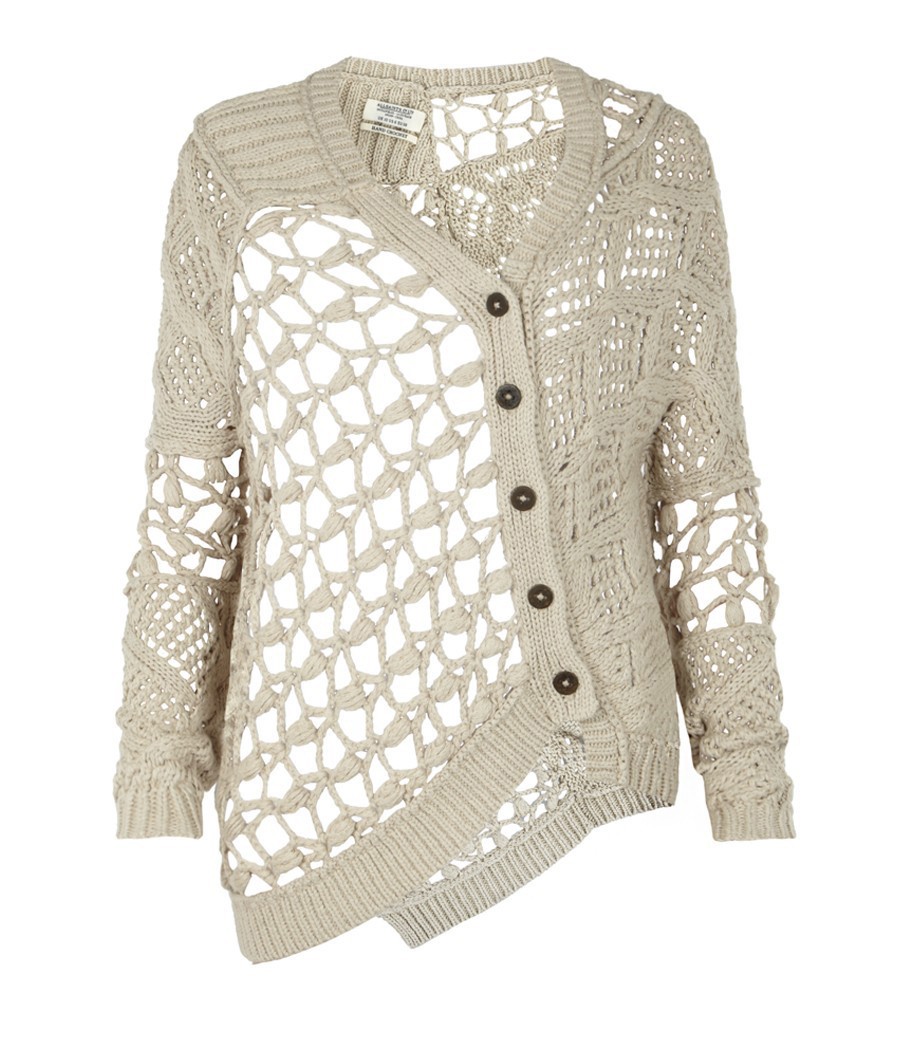
Cotton/linen deconstructed cardigan created on the stand using vintage jumpers. The Summer Court cardigan combines paneled and open work crochet with lace stitches and fastens along the asymmetric placket with signature dark rust metal buttons. A new take on an Aran cardigan.
Fabric 55% Linen 45% Cotton
Text taken from http://www.allsaints.com/women/knitwear/allsaints-summer-court-cardiga/?colour=940&category=26 (allsaints clothing website)
The idea of working with old clothing and getting new ideas, shapes and outcomes from them is somthing All Saints company does as well. I work for this company and we had a workshop explaing the new and invative techniques they used to create this seasons trends. Stated above by the company they used vintage jumpers and cardigans, cut them up and re-assembled them on mannequins to achieve these unique shapes.

Monday, 12 March 2012

Goodone


Goodone is an award wining independent fashion label that reflects contemporary London through conscious, modern design. They believe that an intelligent approach to design should not only be satisfy a hunger for new and constantly evolving concepts in style, but should also address the environmental impact of the fashion industry. They specialise in Up-Cycling innovatively combining new British and sustainable fabrics with reclaimed textiles. They have developed a design method which is informed by the use of Recycled, but not restrained by it.


goodone.jpg (740×493)
GOODONE-2_1716749a.jpg (409×409)
Screen-shot-2010-04-09-at-11.18.40-PM-205x400.png (205×400)


 I think the way this artist works is very inspiring to new generations of designers. In our group work we would like to up cycle clothing. However collecting all the clothes from one community.